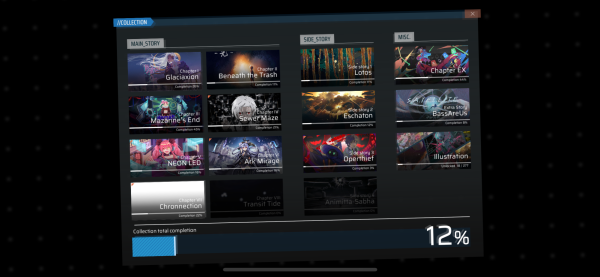
“Phigros” is a laneless rhythm game released on September 28, 2019 for iOS and Android devices. It hosts a massive collection of songs broken down into a plethora of named collections, some of which connect to an overarching story of the game told in excerpts and cutscenes.
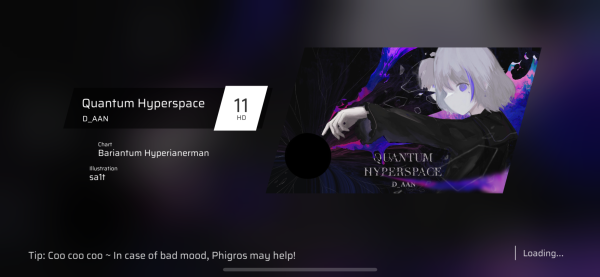
Every song has multiple difficulty levels ranging from Easy (EZ) to Another (AN), each with its own unique charting. The difficulty names are not the most accurate way of telling how difficult a song is, though, as they really only rank difficulty in context of the other difficulty levels of the individual song. Rather, a numbering system tells players how difficult the charting will be in the context of the entire game. This is not an unusual difficulty ranking system to see in rhythm games, and definitely my favorite way of doing it.
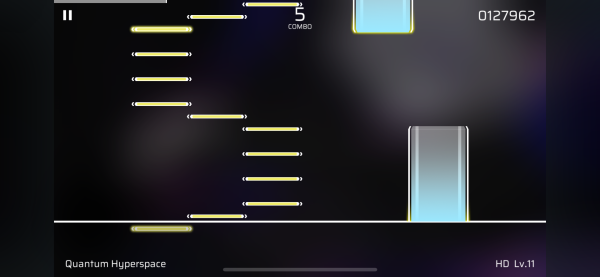
While in a song, there will be four types of notes coming towards the white bar called the Judgement Line, which is a white bar that judges the accuracy of a player throughout the song. The notes coming towards the Judgement Line are called Tap, Hold, Drag, and Flick. The most basic of these is the Tap note, which will be signified by a small, horizontal blue rectangle. All the player has to do with a Tap note is tap the location of the screen it is on when it gets to the Judgement Line for a good accuracy score.
Next is the Hold note, which looks like the Tap note, but with verticality to it. When a Hold note meets the Judgement Line, the player will have to tap and hold until the entirety of the note is gone in order to get the best accuracy possible.
Third up is the Drag note, which will be a very thin, horizontal yellow rectangle. These are a combination of the Tap and Hold notes. They will come one at a time, but usually in very crowded droves. To deal with these notes, the player will have to tap and hold on their screen while moving their finger to the location of the next upcoming Drag note so that it will disappear with full marks on accuracy.
Finally, there is the Flick note, also known as the bane of my existence. When this note meets the Judgement Line, the player has to tap where the note is and quickly swipe in any direction. Luckily, the developers threw the players a bone and made it so that the player’s finger does not have to lift off of the screen to make the note disappear, which is an especially useful feature when there are multiple Flick notes coming one after the other. Each of these notes allows for the charters to make a very interesting and entertaining gameplay loop by combining them in fun and unique ways.
After completing a song, the player’s accuracy will be ranked with one of these rankings: F, C, B, A, S, a white or blue v (Nu), or a golden φ (Phi). Phi is the most prestigious of the rankings, representing a perfect full combo (100% accuracy). A blue Nu represents a full combo with an accuracy of less than 100%, a white Nu represents getting between 96% and 99.99% accuracy without a full combo, S is between 92% and 95.99% accuracy, A is between 88% and 91.99%, B is between 82% and 87.99%, C is between 70% and 81.99%, and F is anything less than 70%.
An A or higher score on any difficulty will be counted as a passing score, most times allowing the player to play the next song in the collection, although some songs are accessed through other means, such as unlocking them with currency gained from beating songs or by fulfilling special requirements on other songs. This accuracy ranking system is very intuitive, and also not unusual to see in other rhythm games.
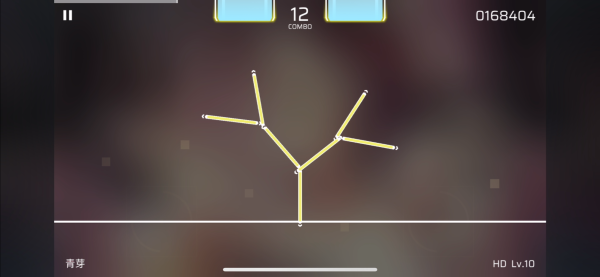
Because Phigros is laneless, the charters can use their creativity all throughout the songs, from the notes moving away from where they were headed for to multiple Judgement Lines
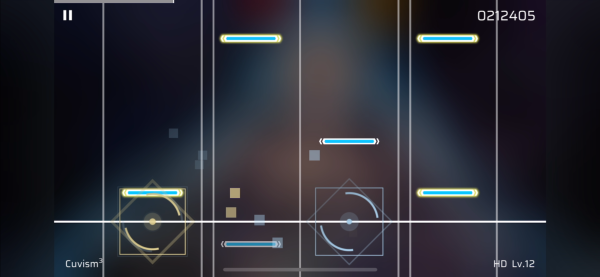
being on screen at once. One of my favorite levels to try and get a better score on occasionally even reintroduces the concept of lanes, which makes the game surprisingly harder if the player only uses two fingers to play. Most levels will also have a visual side to them if the charter pleases, usually giving the player a break from hitting notes to look at funny moving objects for a few seconds. Easier difficulties will generally not have as interesting of a visual side, which makes it all the more gratifying to be able to complete the harder ones.
The story of the game is slowly unlocked throughout a player’s time in “Phigros,” but I honestly have not paid much attention to this aspect of the game. A lot of the story excerpts are in Chinese, which makes it difficult for players like me to be able to learn the story without going to websites like Reddit, YouTube or Fandom for help. From what I have heard of the story, though, the basis seems to be about rogue AI and a post-apocalyptic planet with very few survivors.
Another great aspect of the game is the absolutely stunning art for song covers, collection covers, loading screens and more. Putting aside the fact that most of it is conventionally attractive anime women, the different art styles and techniques shown throughout deserve some type of award if one has not been given already.
All in all, “Phigros” is one of the best rhythm games I have ever played and the fact that it is completely free astonishes me. I would genuinely pay for this product because it is just that good of an experience. This game receives a perfect φ, and its reward is a fervent recommendation from me.


